Do I Snore or Do I Have Sleep Apnea? Key Differences and Red Flags
June 16, 2026Snoring is common, so it is easy to brush it off as just an annoying sleep habit. Maybe your partner nudges you at night. Maybe you wake up with a dry mouth. Or maybe someone tells you that your snoring is loud enough to hear from another room. At that point, it makes sense to wonder whether this is just snoring or something more serious, like sleep apnea.
The main difference is breathing. Simple snoring happens when air moves past relaxed tissues in the throat and causes vibration. Sleep apnea, however, involves repeated pauses or reductions in breathing during sleep. Those pauses can lower oxygen levels, interrupt sleep, and leave you tired even after a full night in bed. Loud snoring, gasping, choking, and pauses in breathing are all signs worth taking seriously.
At ADC Dental Group in Joplin, MO, Dr. John C. Durling can talk with you about your symptoms, look for oral signs that may be connected to airway issues, and help you understand when a sleep evaluation may be needed. A dentist does not diagnose sleep apnea without proper sleep testing, but dental visits can be a good place to bring up snoring, dry mouth, grinding, and other sleep-related concerns.
What Is Snoring?
Snoring happens when airflow is partly blocked during sleep and the soft tissues in the throat vibrate. It may be mild, occasional, or loud enough to disturb someone else’s sleep. For some people, snoring gets worse when they sleep on their back, drink alcohol before bed, have nasal congestion, or are especially tired.
Simple snoring does not always mean you have sleep apnea. Some people snore without having breathing pauses, oxygen drops, or major sleep disruption. However, snoring is still worth paying attention to when it is loud, frequent, or paired with other symptoms.
For example, occasional snoring during a cold may not mean much. But if you snore most nights, wake up choking, or feel worn out during the day, that is different. Then the snoring may be part of a bigger sleep-breathing problem.
So, snoring by itself does not tell the whole story. The pattern matters. The volume matters. Also, what happens between the snores matters too.
What Is Sleep Apnea?
Sleep apnea is a sleep-related breathing disorder where breathing repeatedly stops and starts during sleep. Obstructive sleep apnea is the most common type. It happens when the airway becomes blocked or partly blocked during sleep, often because the soft tissues in the throat relax and narrow the airway.
When breathing pauses happen, your body may briefly wake you enough to reopen the airway. You may not remember waking up, but your sleep can still be interrupted again and again. Because of that, you may spend plenty of time in bed and still wake up feeling like you barely rested.
Sleep apnea can show up as loud snoring, gasping, choking, morning headaches, dry mouth, trouble focusing, mood changes, high blood pressure, or daytime sleepiness. Some people do not notice these symptoms themselves until a partner points them out.
That is the difference between snoring and sleep apnea. Snoring is a sound. Sleep apnea is a breathing problem during sleep.
Key Difference: Snoring Makes Noise, Sleep Apnea Interrupts Breathing
The simplest way to compare snoring and sleep apnea is to look at breathing. Snoring makes noise because air is moving through a narrowed space. Sleep apnea involves breathing that repeatedly slows, stops, or becomes blocked during sleep.
With simple snoring, the sound may be fairly steady. With sleep apnea, the pattern may be more uneven. A person may snore loudly, go quiet for several seconds, then gasp, choke, or snort as breathing starts again. That stop-and-start pattern is one of the bigger red flags.
However, you may not know this is happening if you sleep alone. You may only notice the aftereffects, such as morning headaches, dry mouth, poor sleep, or feeling tired during the day. Because of that, sleep apnea can be missed for a while.
So, the question is not only “Do I snore?” It is also “Is my breathing staying steady while I sleep?” Since most people cannot answer that on their own, a sleep study may be needed when symptoms point in that direction.
Red Flag: Someone Notices Pauses in Your Breathing
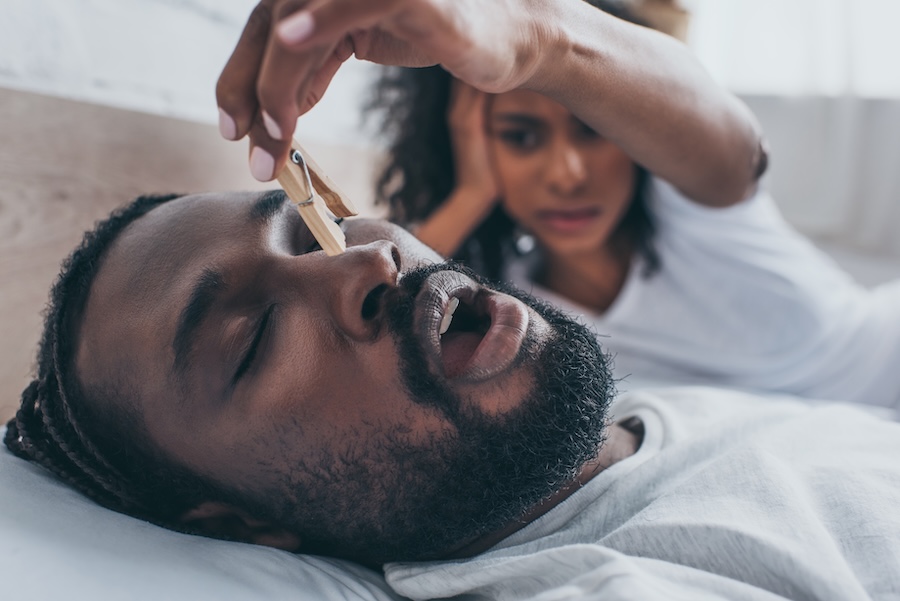
One of the strongest warning signs of sleep apnea is when someone sees you stop breathing during sleep. A partner may describe silence after loud snoring, followed by gasping, choking, or a sudden snort. That can be unsettling to hear, but it is useful information.
Breathing pauses during sleep should be brought up with a healthcare provider. They may be a sign that your airway is not staying open consistently overnight.
If someone has noticed pauses in your breathing, write down what they saw. How often does it happen? Do you gasp afterward? Is it worse on your back? Do you seem restless? Those details can help your dentist or physician decide what type of evaluation makes sense.
Even if you feel mostly fine during the day, witnessed breathing pauses should be checked. Your sleep may be more disrupted than you realize.
Red Flag: Loud, Frequent Snoring
Not all snoring is sleep apnea, but loud, frequent snoring is more concerning than occasional snoring. If your snoring happens most nights, disrupts someone else’s sleep, or can be heard through a closed door, it is worth mentioning.
Obstructive sleep apnea is often associated with loud snoring, especially when snoring is interrupted by pauses, choking, or gasping. Still, volume alone does not diagnose sleep apnea. Some loud snorers do not have apnea, and some people with sleep apnea are not described as extremely loud snorers.
Other symptoms help fill in the blanks. Loud snoring with daytime fatigue, morning headaches, high blood pressure, dry mouth, or choking at night is more concerning than snoring alone.
If your snoring has changed recently, gotten louder, or become more frequent, bring that up too. Changes in weight, nasal congestion, alcohol use, sleep position, medications, and airway anatomy can all affect snoring.
Red Flag: Waking Up Gasping or Choking
Waking up gasping or choking can be a sign that your airway narrowed or closed during sleep. Some people describe it as waking with a sudden need to take a breath. Others wake up coughing, startled, or with their heart racing.
This does not always happen every night. It may be worse when you sleep on your back, drink alcohol, are congested, or are overly tired. However, even occasional gasping is worth discussing, especially if it happens with loud snoring or daytime sleepiness.
If this is happening, bring it up instead of waiting to see if it keeps happening. The timing, frequency, and other symptoms can help show whether your breathing is being interrupted overnight.
A dental visit can help start the conversation, but a medical sleep evaluation is usually needed to confirm whether sleep apnea is present.
Red Flag: Morning Headaches or Dry Mouth
Morning headaches can happen for many reasons, but they may also show up with sleep apnea. If breathing is repeatedly disrupted during sleep, your body may not get steady rest. Some people wake with a headache, jaw tension, or a heavy, foggy feeling.
Dry mouth is another clue. It can happen when you breathe through your mouth at night, snore, or have nasal congestion. It can also raise your cavity risk because saliva helps protect the teeth.
Of course, these symptoms do not prove you have sleep apnea by themselves. They can also come from medications, dehydration, allergies, sinus issues, or grinding.
Still, if you wake up with dry mouth or headaches often, and you also snore, it is worth mentioning at your next visit with Dr. Durling. Several symptoms together can be more helpful than one symptom by itself.
Red Flag: Daytime Sleepiness Even After a Full Night in Bed
Feeling tired after a short night is one thing. Feeling tired after what should have been enough sleep is different. If you spend seven or eight hours in bed but still feel foggy, irritable, or sleepy during the day, your sleep quality may be poor.
Sleep apnea can cause repeated brief awakenings that you may not remember. So, while it may look like you slept all night, your body may not have stayed in deeper, more restful sleep long enough.
Daytime sleepiness, trouble focusing, mood changes, and unrefreshing sleep are commonly reported with obstructive sleep apnea. This can affect work, driving, conversations, and daily patience.
If you are regularly fighting sleep during the day, especially while reading, watching TV, working, or driving, talk with a healthcare provider. Sleepiness behind the wheel should be taken seriously.
Red Flag: High Blood Pressure or Heart Health Concerns
Sleep apnea can affect more than your sleep. When breathing repeatedly stops or slows, oxygen levels can drop, and the body may respond with stress signals. Over time, untreated sleep apnea has been linked with cardiovascular concerns, including high blood pressure.
This does not mean every person who snores has heart problems. It also does not mean sleep apnea is the only reason someone has high blood pressure. However, if you snore loudly and also have blood pressure that is difficult to control, sleep apnea should be part of the conversation.
Some people first hear about possible sleep apnea from their physician. Others hear about it from a dentist who notices signs like worn teeth, dry mouth, jaw strain, or airway-related concerns. Either way, proper sleep testing is usually the next step.
If you already have heart health concerns, do not rely on guesswork. Ask your physician whether your sleep symptoms should be evaluated.
Red Flag: Grinding, Clenching, or Jaw Soreness
Grinding and clenching can be connected to many things, including stress, bite pressure, sleep disruption, and airway issues. Some people with sleep apnea also grind their teeth at night, although grinding alone does not prove sleep apnea.
You may notice jaw soreness in the morning, worn teeth, chipped enamel, headaches near the temples, or a tired feeling when you chew. A dentist may notice wear patterns before you feel any symptoms.
At ADC Dental Group, Dr. Durling can look for signs of grinding, clenching, tooth wear, broken dental work, and jaw strain. Then, if your symptoms also suggest possible sleep apnea, he may recommend a sleep evaluation before any appliance is considered.
A night guard for grinding and an oral appliance for sleep apnea are not the same thing. A regular night guard protects teeth from grinding. A sleep apnea oral appliance is designed to help position the jaw and airway during sleep.
Can a Dentist Tell If I Have Sleep Apnea?
A dentist can notice signs that raise concern, but sleep apnea needs proper diagnosis through sleep testing. That may involve an at-home sleep test or an in-lab sleep study, depending on your symptoms, health history, and physician’s recommendation.
During a dental exam, Dr. Durling may ask about snoring, dry mouth, morning headaches, clenching, daytime tiredness, or whether anyone has noticed breathing pauses. He may also look at your bite, jaw position, tongue, palate, tooth wear, and airway-related risk factors.
However, those signs are not enough to diagnose sleep apnea. They are clues. From there, you may be referred to a physician or sleep specialist for testing.
So, if you bring up snoring at the dentist, that does not mean you will automatically be told you have sleep apnea. It means your symptoms can be sorted out more carefully.
How Sleep Apnea Is Diagnosed
Sleep apnea is diagnosed with sleep testing. A sleep study measures breathing patterns, oxygen levels, heart rate, sleep stages, movement, and other factors while you sleep. Depending on the situation, testing may happen at home or in a sleep lab.
The results show whether breathing is stopping or slowing during sleep and how often it happens. That information matters because treatment depends on the type and severity of sleep apnea.
A phone app, smartwatch, or snoring recording may give hints, but those tools are not the same as a diagnosis. They may be useful notes to bring up, but they should not replace a proper evaluation.
If your symptoms point toward sleep apnea, Dr. Durling can help guide you toward the right next step. Your physician or sleep specialist can then confirm the diagnosis and discuss treatment options.
Treatment Options for Snoring and Sleep Apnea
Treatment depends on what is causing the problem. For simple snoring, changes like sleeping on your side, treating nasal congestion, limiting alcohol before bed, or addressing weight-related risk factors may help some people.
For diagnosed sleep apnea, treatment may include CPAP therapy, oral appliance therapy, lifestyle changes, medical management, or, in some cases, surgery. CPAP is often used to keep the airway open during sleep. Oral appliance therapy may be an option for certain patients with obstructive sleep apnea, especially when recommended as part of a coordinated treatment plan.
A dental sleep appliance is custom-made and different from a store-bought mouth guard. It is designed to help keep the lower jaw and airway in a better position during sleep. However, it should be used only after proper diagnosis and guidance.
At ADC Dental Group, Dr. Durling can discuss whether oral appliance therapy may be appropriate after sleep apnea has been diagnosed. If CPAP is already working well for you, that may still be the best option. If it is not, it is worth asking about alternatives.
When Snoring Is More Likely to Be Just Snoring
Snoring may be less concerning when it happens only occasionally and has a clear trigger. For example, you may snore during a cold, allergy flare-up, after drinking alcohol, or when sleeping on your back.
If you wake up feeling rested, do not have daytime sleepiness, and no one has noticed gasping or breathing pauses, simple snoring may be more likely. However, frequent or worsening snoring is still worth mentioning, especially if it is disrupting sleep in your household.
Snoring can still affect sleep quality for you or your partner. It may also be a sign of nasal blockage, enlarged tonsils, congestion, or other airway narrowing.
So, if snoring is frequent, loud, or changing, ask about it. Occasional snoring and sleep apnea symptoms are not the same, and it helps to know which one you may be dealing with.
When to Talk With a Dentist or Physician
Talk with a dentist or physician if you snore loudly most nights, wake up gasping, have morning headaches, feel tired during the day, or have been told you stop breathing while asleep. These symptoms are common reasons to consider sleep apnea evaluation.
You should also speak up if you grind your teeth, wake with jaw soreness, or have a dry mouth every morning. These signs may not always mean sleep apnea, but they can help complete the picture.
If you have high blood pressure, heart concerns, or severe daytime sleepiness, bring those up with your physician as well. Sleep apnea care often works best when dental and medical providers are both involved.
And if you feel sleepy while driving, do not wait for a routine appointment. That is a safety issue and should be discussed promptly with a healthcare provider.
Snoring and Sleep Apnea Help in Joplin, MO
Snoring and sleep apnea can sound similar at first, but they are not the same thing. Snoring is the sound of restricted airflow. Sleep apnea involves repeated breathing interruptions during sleep. So, the biggest red flags are loud frequent snoring, pauses in breathing, gasping, choking, morning headaches, dry mouth, and daytime sleepiness.
At ADC Dental Group in Joplin, MO, Dr. John C. Durling can talk with you about your symptoms, check for dental signs of grinding or airway concerns, and help you understand whether a sleep evaluation may be needed. If sleep apnea is diagnosed, oral appliance therapy may be one treatment option depending on your case.
If your snoring has started to raise questions, or if someone has noticed breathing pauses while you sleep, schedule a visit with ADC Dental Group. A conversation and exam can help you figure out whether this is likely simple snoring or something that needs a closer look.
FAQs
How do I know if I snore or have sleep apnea? Snoring is a sound caused by vibration in the airway. Sleep apnea involves repeated pauses or reductions in breathing during sleep. Loud snoring, gasping, choking, daytime sleepiness, and witnessed breathing pauses are signs that sleep apnea should be evaluated.
Can you have sleep apnea without loud snoring? Yes, it is possible. Loud snoring is common with obstructive sleep apnea, but not every person with sleep apnea snores loudly. Other signs may include daytime sleepiness, morning headaches, dry mouth, or witnessed breathing pauses.
Is snoring always a sign of sleep apnea? No. Some people snore without having sleep apnea. However, loud, frequent snoring is more concerning when it comes with gasping, choking, daytime tiredness, morning headaches, or pauses in breathing.
Can a dentist help with sleep apnea? A dentist can screen for signs that may suggest sleep apnea and may provide oral appliance therapy for certain diagnosed cases. However, sleep apnea must be diagnosed through proper sleep testing, usually ordered or reviewed by a physician or sleep specialist.
What are the biggest red flags for sleep apnea? Major red flags include loud frequent snoring, breathing pauses during sleep, waking up gasping or choking, morning headaches, dry mouth, daytime sleepiness, trouble focusing, and high blood pressure.
Should I use a mouth guard for snoring? Do not use a regular mouth guard to treat suspected sleep apnea. A night guard for grinding is different from a custom oral appliance used for sleep apnea. If sleep apnea is suspected, proper testing should come first.
Categorised in: Sleep Apnea